Here’s another true tale for my story stockpile. . .
When I got out of bed early on April 9 I veered left as I walked, bumping into the wall of the hallway to our bathroom. My vision seemed to be twirling, my head felt fluttery drunk, and I had an undeniable urge to fall to the floor.
Vertigo. Just like 11 years ago during my summer of chemo.
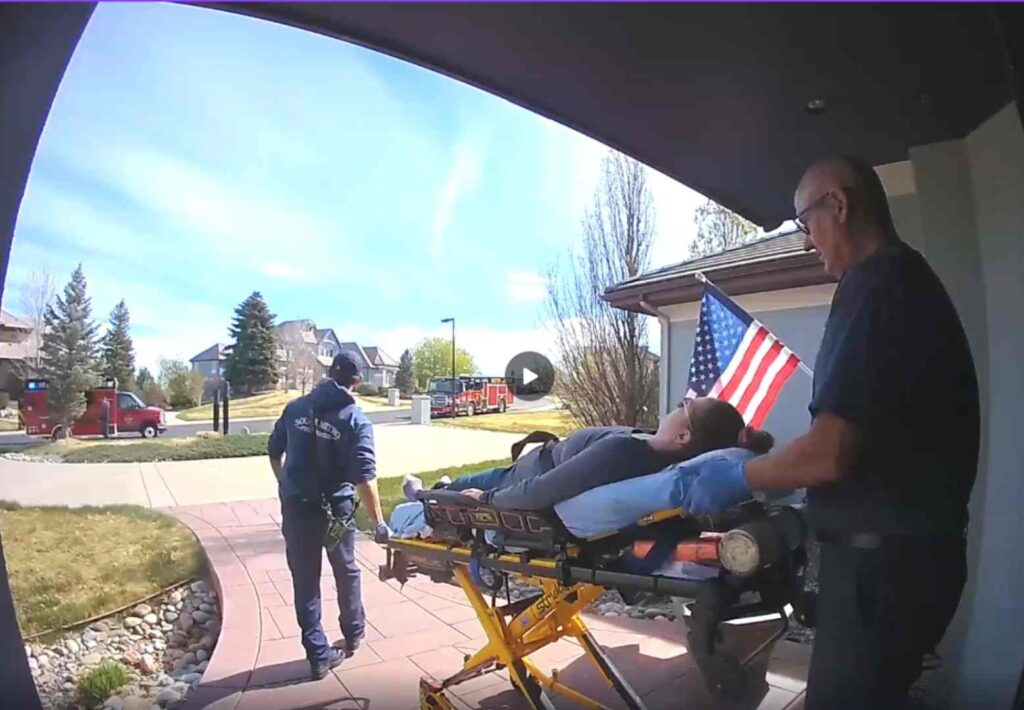
Clutching my hands to the hallway walls for support, I staggered back to bed and lay motionless. Whenever I raised my head I got sick, so five hours later I asked Rene to call 911 so I could be gurneyed to the emergency room. My balance was so unstable I didn’t have the energy to crawl across the floor to get to the car.
Minutes later, firefighter paramedics from the South Metro Fire station up the hill arrived, swooping in like Navy Seals of first responders. Once the ambulance crew arrived, I counted eight hunky, tanned men standing around our bed while I lay there helpless in my pajamas with bad breath and no makeup, trying not to barf.
Why, oh why, do I manage to end up on display in these bizarre situations?
My “let’s use humor to diffuse this embarrassing moment” character trait kicked in and I fought back the impulse to ask Rene to hand me my phone so I could take a once-in-a-lifetime photo. The journalist in me will never die.
While he wheeled me out, an ambulance crew member who helped me out of bed and strapped me on the gurney admitted he had taken a few moments to look around.
“Your house is very unique and I love the mountain views,” he said.
“You wanna buy it?” I asked, not at all joking.
Once we arrived at AdventHealth Littleton hospital’s ER, the nurse practitioner in charge needed to determine whether I’d had a mini-stroke or heart attack, so she ordered a brain MRI, EKG, CAT scan, and echocardiogram, plus time with a physical therapist to teach me the Epley maneuver. The maneuver is a specific series of head and body movements used to treat the spinning sensation known as vertigo.
Seven hours in the bowels of the ER later, I was transferred upstairs to a hospital room. Thankfully, all my test results came back normal and I was released late the following day. The official diagnosis was Benign Paroxysmal Positional Vertigo (BPPV). It’s a common inner ear problem that causes brief, intense episodes of vertigo, usually triggered by tilting one’s head up or down, lying down, or turning over in bed.
For the rest of April I stayed home, didn’t drive, and attempted the Epley maneuver on my own multiple times daily. I couldn’t concentrate (thank you, brain fog), often felt nauseous, and was perpetually fatigued. I held on for dear life whenever I attempted to navigate stairs.
Three weeks later, I was completely fed up with feeling woozy, worthless, and exhausted, so one afternoon I attempted the Epley maneuver with vengeance and determination. When I sat down and put my legs straight out in front of me on the long side of the cushioned bench in our bedroom, I turned my head right 45 degrees, then quickly lowered my torso so my head hung over the edge. I knew the crystals were in motion because my head felt fluttery, so once the fluttering stopped I rapidly flipped onto my left side, tightly holding on to the bench so I didn’t roll off. After 30 seconds I turned on my stomach and tilted my head down to look at the floor.
My vision suggested I lurched violently when I turned, but I didn’t move at all. It was a sign. Proof that those pesky crystals had finally made it back to their proper home.
Hallelujah and glory be!
So, what’s the deal with BPPV? Well, inside the vestibule of the inner ear, there are thousands of microscopically tiny calcium carbonate crystals called otoconia. Each is about half the width of one human hair. Occasionally, otoconia become dislodged and float into the ear’s semicircular canals, which control balance. When the loose crystals shift, sometimes false signals are sent to the brain that the body is spinning. The Epley maneuver uses gravity to guide the misplaced crystals out of the sensitive semicircular canals and back into an area of the ear where they won’t cause dizziness.
The incidence of BPPV tends to spike significantly after the age of 50 for all sorts of reasons. I plan to have vestibular therapy, but not until I complete six weeks of physical therapy for osteoarthritis in both knees, which I had to put off because of the long recovery period from BPPV. I’ll get there, eventually.
Some final thoughts:
There’s nothing preventive I can do for my inner ear sensitivities, but I keep researching and talking with those who struggle with BPPV.
The brain works extra hard in the aftermath of BPPV to sort through mismatched signals (e.g., your eyes tell your brain you’re still, but your ear tells your brain you’re spinning). Exhaustion is a common result.
To completely recover, which can take weeks, the brain has to physically recalibrate how it processes balance, often learning to ignore the “broken” ear signal and rely more heavily on vision and touch.
Too much sugar in my diet, spring hay fever that causes inner ear inflammation, and attempting to walk inside buildings with tall ceilings appear to be the primary triggers that throw my equilibrium off.
And there you have it. Grateful thanks to my husband, Rene, for being such a committed caregiver, to Aurora Chamber of Commerce President Naomi Colwell for her support and understanding, to the outstanding firefighters and paramedics from South Metro Fire Rescue, and to the many healthcare professionals I’ve worked with who admit they are seeing more cases of BPPV than ever before.